
 Over the past few weeks I’ve made several clearance arbitrage scouting trips. After hearing about this side hustle for the past year and some of the success my friends and peers are having with it, I had to give it a shot!
The first thing I did was install the Amazon Seller app (Android | iOS) on my phone. I know others have recommended Profit Bandit, but the Amazon one was free so that’s what I started with.
Upon opening it, I learned an Amazon Seller account was required to run it, so I created a free Amazon Seller account.
(I later upgraded to a “Professional” Seller account, for $39.99 a month after a 1-month free trial, but started out with just the free one.)
Armed with my iPhone, I took to the aisles!
My first stop was Walgreens. I found a few items, including this dancing Groot toy from Guardians of the Galaxy.
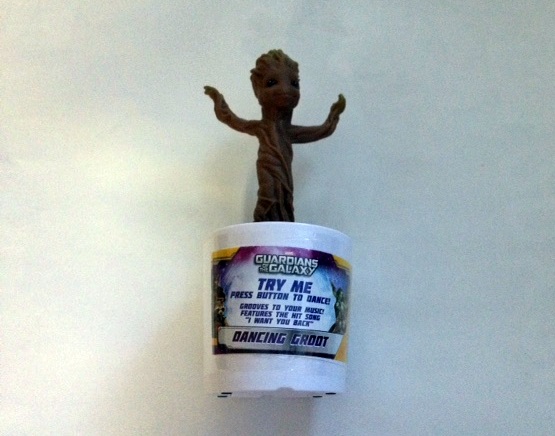
It was on sale for $3.79, and the barcode scan indicated my estimated gross proceeds would be $12.41. It also had great ratings and a low sales rank in the Toys category. Unfortunately this was the only one they had, otherwise I would have bought the whole stock!
Many of the items I scanned were shown as “restricted” in the app; meaning I couldn’t sell them. I learned later that certain categories, like Automotive and Beauty, require a special application (and a Professional Seller account) to list those items.
I also hit up:
- Target
- Safeway
- OSH (local hardware store)
- Walmart
- CVS
- Radio Shack
- Big Lots
- Office Depot
Radio Shack, CVS, Office Depot, Big Lots, and Safeway were busts, but I did find a few items at each of the other places.
In total, I spent 5-6 hours shopping and spent about $300 so far.
Product Scanning
Scanning is a little awkward at first, especially at smaller stores with employees watching. But it was also strangely addicting. Like a little treasure hunt.
In “real life,” I spend very little time shopping. Like, almost never aside from the grocery store.
I don’t buy much and what I do buy, I usually just order from Amazon. So for me, there’s going to be a learning curve in each location to find where the clearance items are generally found and what to look for.
I knew from reading posts like Travis’ that it would take a lot of scanning to find profitable items, but in practice that was more depressing than anticipated.
To leave a store empty-handed after 45 minutes felt like a big waste of time.
Amazon FBA Arbitrage Purchase Criteria
Being a total rookie at this, I didn’t know what exactly I was looking for. I knew that basically I was looking for a healthy spread between my purchase price locally and the “net proceeds” of the item on Amazon (after seller fees).
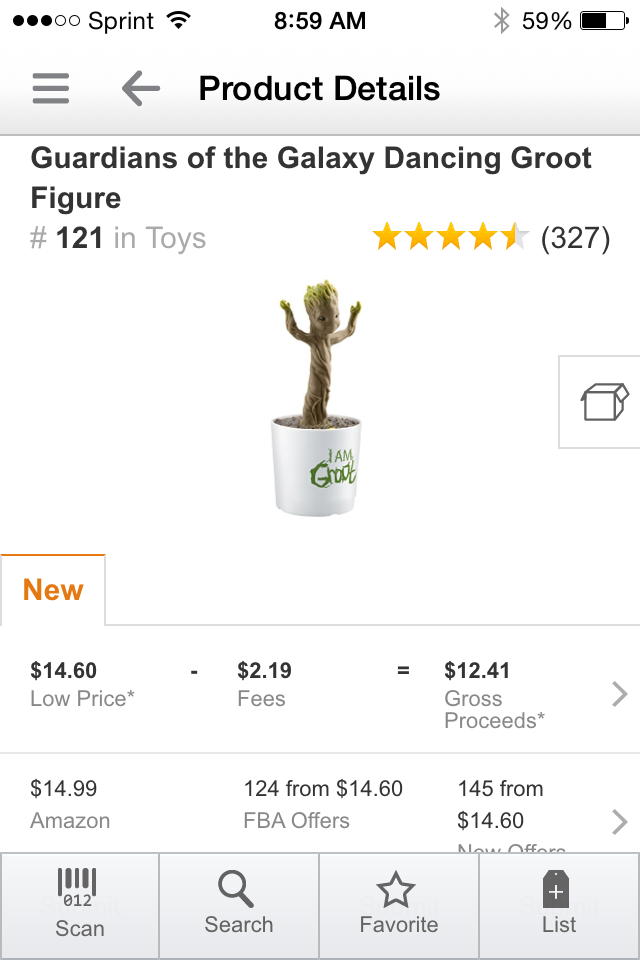
The other consideration I took into account was the size and weight of the item, reasoning that big and bulky products would be more costly to ship into the warehouse and cut into my margins.
In general, I looked for items that were marked down at least 50% and had estimated profits of $5 or more. If I felt particularly confident about an item, I’d buy two or three.
Getting Gun Shy
I scanned a couple items that looked like winners, but I didn’t end up purchasing for one reason or another. In one case, the packaging was so beat up I wasn’t sure if Amazon (or the end customer) would accept it as “new.”
In another case, a product appeared to have a great spread between the in-store price and the Amazon price, but it had horrible customer reviews. I got freaked out that no one would buy a 1-star rated product and it would just sit in the warehouse.
FBA sellers, do you let the condition of the packaging or the reviews come into consideration on your scouting trips?
What other criteria do you use?
What I Bought to Resell on Amazon
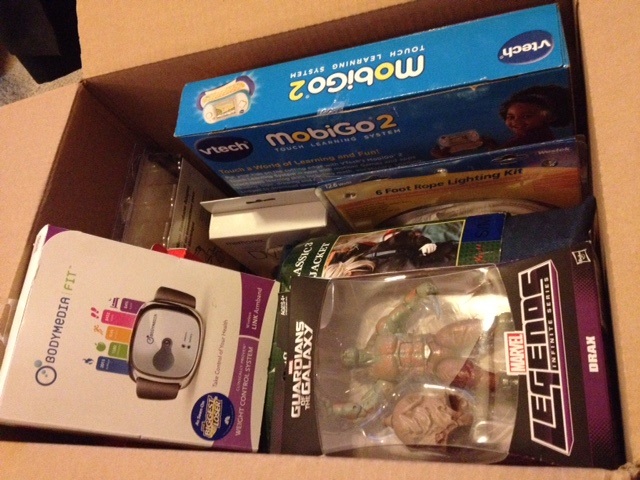
I ended up with mostly toys and some electronics and accessories. Here’s my first shipment I sent off to Amazon:
Related: The best items to flip for a profit.
Want to know what else is crazy? That 10 pound box only cost $8.56 to ship across the country using Amazon’s discounted UPS rates.
One frustrating thing I didn’t really anticipate was when entering in my items in my Seller account was they wanted items shipped to several different warehouses across the country. I guess I knew they had distribution centers all over the place, but for some reason thought I would be able to send all my stuff to one location.
My current game plan is to batch as many items as I can into each shipment to spread the shipping cost across the inventory.
The cool thing is they deduct the super-cheap shipping charges directly from your account so you’re not pulling out your credit card for each box.
Entering the inventory into Amazon’s system and creating the shipments also took some time to learn, since I’d never done it before. They’ll throw unfamiliar terms and requirements at you at every corner, and you just have to push through.
For instance, a couple of the items apparently needed special labeling. A few clicks later and I found the option for Amazon to do this for me for like $0.20 an item. Not worth worrying about at this point.
If you want to learn more about reselling on Amazon, my friend Jessica has put together a free 7-day email course.
Other Doubts and Risks About Amazon Arbitrage
My analytical brain has a hard time with this side hustle.
If these products are such a good deal, how come the store hasn’t been able to sell them? How have the employees who work there not heard of this business yet? How long can this last?
And what about the stores themselves? Walmart isn’t stupid. They know we’re coming in and doing this.
On the risk side, the $300 I spent is the most physical “inventory” I’ve had since my painting days. Everything else has been digital!
Inventory risk is the idea of “tying up” your money in stuff and then having it sit around a long time before selling or potentially lose value. Amazon does charge a nominal storage fee for warehousing your items, so you want to try and pick out stuff that will sell relatively quickly.
Amazon FBA Tax Notes
If you want to give this a shot, be sure to save your receipts. Otherwise it can be hard to claim a deduction for stuff you bought at Walmart/Target.
Also be sure to keep track of your mileage to and from the stores. (This can be a great tax-saving hack if you’re already making a trip nearby; just stop in and do some FBA scanning.)
My First Amazon FBA Clearance Arbitrage Sales
It took about a week for my first shipment to make it to Amazon’s warehouse. They inventoried the items late on Thursday or early on Friday.
Saturday morning, I pulled out my phone to check and see if anything sold, and was pleasantly surprised to see this:
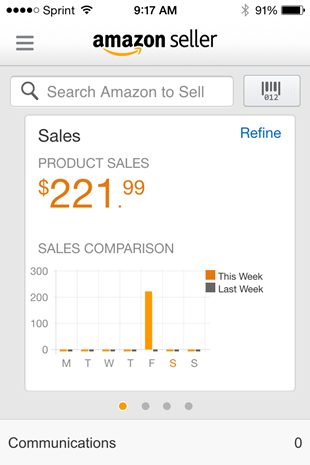
Whoa! $221 in 1 day! Granted, only a small bit of that is profit, but it was still really encouraging to see.
What sold?
- 2 Trolling Motor Adapters (no idea what these are even for): Bought for $7 each and sold for $15 apiece.
- The BodyMedia armband thingy pictured above: Bought for $69 and sold for $115.
- The vTech MobiGo2 thingy pictured above: Bought for $15 and sold for $34.
- The Drax figure from Guardians of the Galaxy, pictured above: Bought for $15 and sold for $28.
- A dinosaur pattern Boppy slipcover: Bought for $10.99 and sold for $14.99.
That last one was an “oops” — either me making a rookie mistake or the cashier ringing me up at the wrong price. I’ll blame the cashier :)
Why was it an oops? Because you don’t keep 100% of the sales price; Amazon still has to take their cut.
On that Boppy slipcover, the fee was $4.92. Definitely went backward on that sale.
It’s something I have to be smarter about when considering these purchases. Or double-checking my receipts before walking away.
Estimated “profit” from the first day of sales: $50.
Actually it’s a little less if I calculate in the lovely California state sales tax and allocate a portion of the shipping costs to those items. But hey, taking action and learning along the way.
I’ve got more inventory on the way from my first shopping trips, and as I get better at this, I suspect my equivalent hourly rate will improve considerably.
Maximize Your Spending
One easy to way improve your margins is to take strategic advantage of credit card rewards. Most cards will earn 1-5% cash back, but you can bump that up to 15-30% or more with certain sign-up bonuses.
I put together a free course on how it all works here: Credit Card Rewards 101: How to Earn Free Cash and Travel by Spending Smarter.
Goals for this Side Hustle
My first goal was to buy $100 worth of stuff to ship off to FBA, and to make my first sales. I can officially cross that off!
The next stage would be to see if this is something I enjoy doing (so far it is, but admittedly I’m still in the honeymoon phase). If it could turn into a $100/week side hustle, it would more or less cover our grocery expenses.
Related: Erase Your Expenses with The Side Hustle Snowball
I like to frame these mini business experiments along those lines because it makes them more tangible, like “we’re eating free this month thanks to Amazon FBA.”
And finally, I’m looking at this as a gateway into ecommerce with Amazon, potentially going down the importing and private label path. Aside from my self-publishing efforts, it’s another interesting way to make money on Amazon.
Want more retail arbitrage goodness? Check out the podcast episodes I did with Travis Scott and Assad Siddiqi. Assad in particular has taken this hustle to an entirely new level, including sourcing products online and outsourcing his packaging and labeling.
Your Turn
Have you tried this yet? I found it super simple to get started, but does require some upfront investment that’s somewhat speculative.
Pin it for later:

************
(Walmart image credit)
I’m not sure if I’m seeing the passive income benefit in this side hustle. It seems like a LOT of work for the money. And, like you, I don’t shop much, so I don’t know if I’d have the requisite skills to pick the winners. And 6 hours shopping means 6 hours less content production.
On the other hand, as a quick way of earning money, this could be useful. I’ve got to admit that now I’m thinking that if I AM shopping, perhaps I should be more mindful of what’s on the shelves. So overall I’m glad you’re exploring this avenue, Nick.
Yeah definitely not passive at this point, but could be a gateway into a more passive model (importing / private-labeling products). Still, pretty fun to test it out and see how it all works.
It can become what I will call ‘semi-passive’ in that once you find a home run product that meets your buying requirements (low sales rank, few FBA sellers, great margin) and it is a regular priced store item (not on clearance/no longer available), you can just continue to replenish that product over and over again in your Amazon inventory. So you only had to find the product once, then when you are running low, you just got buy more of that same product (or products as you build up your inventory) and don’t need to spend the time always scanning for new items. Replenishing inventory is where you can really start to see the money rolling in. Scanning constantly is a time killer for sure and not passive, but once you know what to buy/sell, there is much less time involved for the profits.
I’m an international seller, just want. To starts selling on Amazon, I’ve choosen my product from a china supplier , it is a screen protector for iphone i want to target US market by Amazon I don’t have address in USA, to add product in Amazon inventory seller central I need a UPC or EAN or ASIN ….. Code.. I cannt skip this step from Amazon it’s a must, how can I proceed in this matter?thanks
Salam Ahmed
Here’s your answer
https://youtu.be/J-cJ4p8_q8o
Hey Nick,
So glad to hear you’ve given retail arbitrage a try! I’ve been a listener/reader for well over a year now. But, I’m a farmer with very long hours and haven’t really had the time to dive into anything yet. And that’s what appeals to me about this opportunity. You can put in your hours when you’ve got them and everything just sits put until your next block of time becomes available.
So, last month I spent a couple of my previous days off sourcing product for Amazon FBA. I ended up spending a similar amount to you on inventory. Within two weeks of Amazon receiving my products I’ve sold about 35 of the 50 items I sent in and have already received over %100 ROI. Overall I spent about 6-8 hours sourcing and another 4 hours or so online preparing my shipment and trying to learn the correct way to do so.
As far as items with bad reviews, I haven’t purchased anything with less than 3 stars. I just can’t believe many people are buying 1 or 2 star rated items.
I did run into a couple items that were “new” but the packaging was not in satisfactory condition. I do the gift test: if I would feel comfortable giving this item as a gift then I’ll sell it as new on Amazon. Selling as Like New on Amazon is one option, but with one of these items I had great success on Ebay. Ebay allows you to sell items as “New-Other” for those not technically new items. I just made to take great pictures highlighting how new item actually was, but also showing the not-so-new issues. I also choose not to accept returns (people don’t seem to mind if they are confident in what they are buying). This allowed to to sell a $30 DVD recorder for $265! This item was definitely an outlier that alone raises my ROI mentioned above to over 160%.
Sorry for the long comment, but I’m so pumped about what you’re doing. Thanks so much for everything you do Nick, you inspire me.
-CJ
Whoa nice work! It’s definitely got me looking at shopping in an entirely new light :)
CJ
Don’t get caught up in the star rating. Most people don’t leave ratings when they’re happy. Also, this is very important and probably one of the biggest pieces of advice I can give you. The only thing that matters in selling is that it sells. It doesn’t matter if an item has a 1 star rating out of 5. If its selling 200 units a month, its selling 200 units a month period.
Hi, I am confused about this. Do we need authorization from each brand product that we find at the store. Looking at your pictures here, you got a couple of brands, did you have to contact each brand to authorize you to be able to resell those?
Hey Nick – thanks for sharing. This is Jake (I work for Spencer with Long Tail Pro).
I’ve done quite a bit of FBA on the side over the years and have a tip for you about the multiple box thing with mixed items (also drives me crazy).
If you start out the shipping queue by entering a higher quantity, it will affect how many they tell you to ship where. You can keep going back and forth until you get a shipping arrangement you like better.
So lets say you have 5 random, individual items, and then 8 widgets that are the same. They tell you to send the 5 randoms and 4 of your 8 widgets to Chattanooga and then your other 4 widgets to Phoenix.
Go back and say you have 16 widgets, and move forward again.
Most likely, they’ll now have you shipping 8 widgets to Chattanooga (AKA all of them) and 8 to Phoenix.
Go ahead and finish up the Chattanooga shipment, and then just cancel out that Phoenix shipment.
I’m sure this isn’t an Amazon approved tactic, but I’ve done it plenty of times to consolidate shipments as best I can and it always works.
That’s a good hack — thanks for sharing Jake!
If you turn on the inventory placement option in your account you will only have to ship to 1 warehouse. I think it’s an extra 0.15 fee per item but at low volume it’s the way to go
Thank you SO much for this tip. As one who is just starting out, I was wondering about this as had 16 items (3 different items) and had to ship some of each item to THREE different warehouses.
Your way makes SO much sense!