
 I’ve been excited about alternative investments since my early days as an aspiring real estate investor and peer-to-peer loan shark.
If you’re bored/scared/disillusioned with the “traditional” stock market and mutual fund asset classes, or if you just are curious what else is out there, this post is for you.
The cool thing is we’re living in a golden age of alternative investment opportunities, and it was quite an undertaking to compile these options.
My curiosity in this stuff stems from the question: “What’s the best way to grow money?”
Investing is a way to paid over and over again from work you do once. Or at least that’s how I’m coming to look at it.
Before You Invest
Disclaimer: This article is NOT investment, tax, or legal advice, nor is it a solicitation for investment. I have an affiliate relationship with some of the companies listed below.
Please do your own due diligence when evaluating any investment opportunity, and know that “alternative” doesn’t necessarily mean “better,” since individual needs and goals vary.
There are a number of factors to consider before making any investment, including an “alternative” one. Those include:
- Your current financial situation. Some of these investments are only open to high net worth or high income individuals.
- Your near-term money needs. Is there a chance you’ll need the money for a major purchase in the near future?
- Your investment goals. Are you looking for passive income? Long-term appreciation? Tax advantages?
- Your risk tolerance. Is this “play money” you can afford to lose? Or is this a retirement nest egg you’re counting on?
Net Worth Theory
This would also be a good time to share my “net worth” theory of investing. That is, with any new investment, I’d recommend starting with a small sliver or your net worth, and increasing your holding over time as you feel more comfortable.
Don’t know your net worth?
It’s just assets – liabilities, or what you own minus what you owe.
For a free tool to track all your accounts in one place and get a snapshot of your net worth, you can’t go wrong with Personal Capital.
Once you’re set up, you can check out cool (and nerdy) allocation recommendations like this:
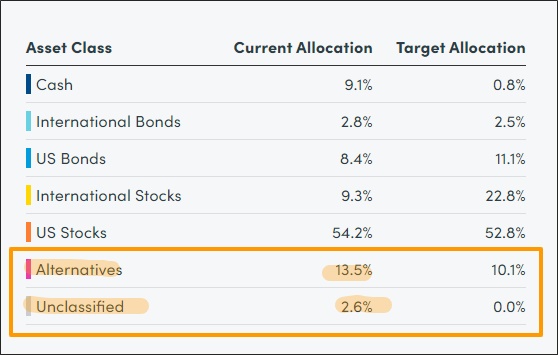
Based on my profile, Personal Capital is recommending around 10% of my portfolio in “Alternatives” — which included real estate.
Where's My Money?
Punch in your name and email below I'll send you the alternative investments I've put my hard-earned cash in.
You'll also receive my best side hustle tips and weekly-ish newsletter. Opt-out anytime.
Alternative Investment Categories
This post is broken into several different “alternative” asset classes, which are then broken down into their openness to accredited and non-accredited investors.
(Accredited investors, in the US at least, are people with a net worth of $1 million or more excluding their primary residence, or who earn $200,000 a year as an individual or $300,000 a year as a married couple.)
You can see some of my top options in each of the categories below, or check out this cool free tool to filter to the ones that are the best fit for you.
Real Estate Investing
Real estate investing comes in many forms, including wholesaling, traditional rentals, house hacking, and everything in between.
Over the last few years, I’ve been increasing my real estate holdings as a percentage of net worth (shooting for around 20% long-term) — and that’s mostly taken the form of public (like Vanguard’s VNQ) and private (like Fundrise, below) REITs.
I like the cash flow and the diversification that comes with owning several properties instead of the liability that could come with just one direct investment. Let’s just say I’ve been burned in the past!
You may not consider real estate “alternative,” but new platforms and technology are opening up new ways to participate in the real estate industry with less work.
For Non-Accredited Real Estate Investors
Fundrise
Fundrise was my first foray into alternative real estate investments (and I have since joined their affiliate program). They have several “eREITs” that own or hold professionally-vetted and managed investments in commercial properties all around the country.
The platform is open to all investors with a $10 minimum and has historically paid dividends every quarter.

What appealed to me with Fundrise was the quarterly cash flow, low minimums, and being automatically diversified in not having to pick-and-choose individual deals. I also like the management team’s long-term vision and strategy in the properties they invest in.
Roofstock
Roofstock is the leading marketplace for “turnkey rental” properties, single family homes that already have tenants and property management in place.
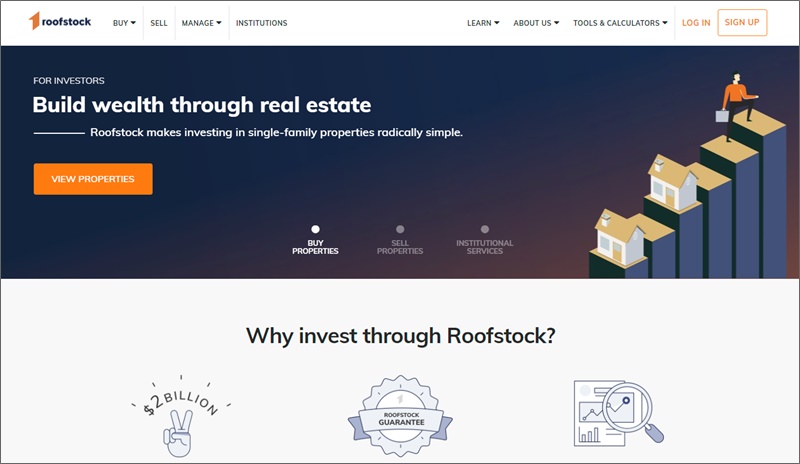
With as little as $20,000 down, you can begin building your real estate empire. Most Roofstock investors are out-of-state buyers, drawn to the platform seeking more attractive investments than they can find in their home market.
If the 1% rule isn’t realistic in your neighborhood, you might find opportunity being a long-distance landlord and generating gross yields of 6-15% based on the listings on their platform.
It’s a slick site to browse and compare deals across multiple states.
DiversyFund
DiversyFund is a newer “eREIT” host made possible by the JOBS Act.
With a minimum investment of just $500, DiversyFund aims to bring investments previously only open to the ultra-wealthy within reach to everyone.

The fund targets “value-add” apartment complexes. These are cash-flowing complexes in need of upgrades – but once the improvements are made, the value of the complex and rental incomes increase.
DiversyFund targets 10-20% returns, but it’s important to note that you should only invest money you don’t expect to need for a while. The company suggests a target 5-year holding period during normal market conditions.
Don’t expect any cash flow in the meantime, either. While your DiversyFund portfolio will generate dividends, those will be “automatically reinvested” on your behalf.
Groundfloor
Groundfloor is a revolutionary player in the private lending crowdfunding space because for a couple reasons. First, their platform is open to non-accredited investors, and second, the minimum investment is just $10 per project.

You pick and choose the deals you want to invest in, and there’s no REIT option at the moment. I made my first loans on Groundfloor earlier this year and will report back on how they perform.
Arrived
A newer entry, Arrived lets you buy fractional ownership of income-producing rental properties. With minimums of just $100 per property, it’s a way to benefit from real estate investing without a huge down payment or other management headaches.
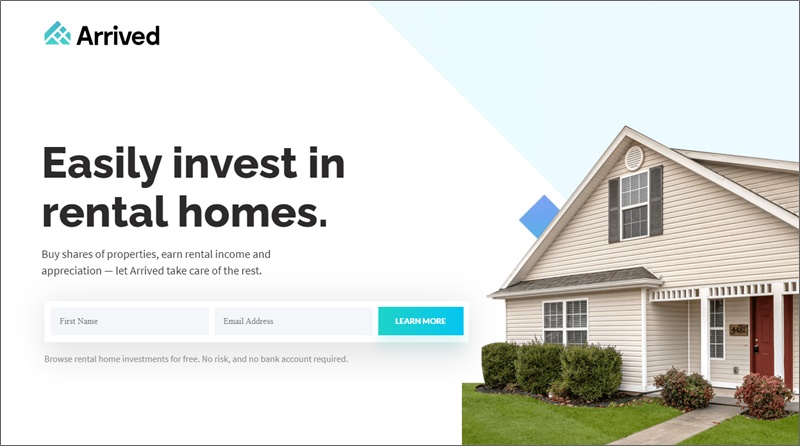
At press time, it looks like you have to pick and choose your deals. Some investors may like that granularity, though I’d love to see a fund option for easy diversification.
RealtyMogul
RealtyMogul was one of the first real estate crowdfunding sites I came across, and they have two REIT options that are open to non-accredited investors with relatively low minimum investments (starting at $5000).
However, at press time, their REITs currently only have 10-11 properties in them, which doesn’t seem particularly diversified. These funds currently pay 4.50-6% annualized distributions on a monthly or quarterly basis.
For accredited investors, the platform also offers private lending deals with minimums ranging from $25,000-50,000.
Other Real Estate Options for Non-Accredited Investors
- HomeUnion provides turnkey rental property search and acquisition services in several markets.
- Doorvest will help you buy and manage out-of-state rental property. The fees are higher here, but they guarantee the rent gets paid.
- YieldStreet – A $1000 minimum can get you into YieldStreet’s “Prism” fund that includes not just real estate, but also art, financial contracts, and more.
Real Estate Options For Accredited Investors
AcreTrader
Invest in America’s farmland with AcreTrader, starting with $5000 minimums. Since 1990, farmland investments have seen an 11% annualized return (according to the site).
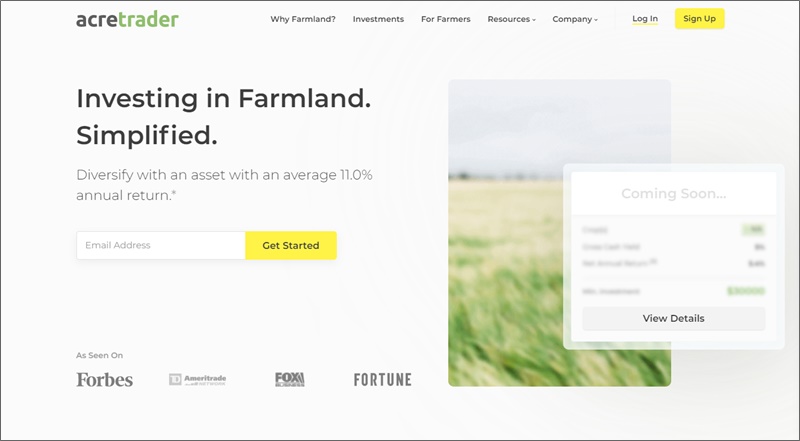
Can’t even keep houseplants alive? Don’t worry — AcreTrader carefully vets each deal, and crowdfunds the purchase of active farmland. Then they rent it back to the farmers who operate it.
AcreTrader investors make money in two ways:
- Appreciation of the land in the event of a future sale
- Annual cash rent payments from farmers.
The company aims for annualized cash distributions in the 3-5% range.
PeerStreet
On PeerStreet, accredited investors participate in private lending crowdfunding deals, usually for fix-and-flip projects on residential properties. Stated returns range from 6-12%. (I’ve earned 6.9% annualized on the platform since 2017.)

What I like about PeerStreet (disclosure: I’m an affiliate and investor) is that the loan terms are short — usually 18 months or less — and they’re backed by real estate that usually carries at least a 30% equity cushion.
The downsides are that there isn’t an “easy button” to diversify across a fund, and the $1000 minimum per property is a little steep for newbies, including me.
The most attractive loans are filled within seconds, so I’ve been using the auto-invest feature to reserve a spot on properties that fit my criteria:

I recently had one property that went into foreclosure, but because of the equity cushion, PeerStreet recouped the entire $1000 principal and some interest as well.
More Real Estate Options for Accredited Investors
- FarmTogether – Similar to AcreTrader above, targeting 8-15% total annualized returns. Minimums are $10,000-50,000 depending on the individual deal.
- EquityMultiple – Buy into high yield, professionally-managed properties for as little as $10,000, with 14.5% historical returns.
- CrowdStreet – $10,000 minimums for hand-selected crowdfunding deals.
- Cadre – Invest in “institutional-quality real estate” on a deal-by-deal basis or through Cadre’s Direct Access Fund. $25,000 minimums.
- Real Crowd – Review and invest in “private money” real estate transactions on commercial property like multifamily buildings, retail developments, office buildings, and industrial buildings. Minimum investments vary by property but range from $10,000-$100,000.
- CityVest – “Insider access” to pre-screened and institutional real estate investments. The site advertises 10-25% passive returns and the minimum investment is usually $10,000.
- Patch of Land – $5000 minimums, targeting 9-12% returns.
- LendingHome – $5000 minimums, targeting 8-10% returns.
- Iintoo – $25,000 minimums, targeting 10-15% returns. This company acquired the assets of RealtyShares, another popular platform in this space.
- PeerRealty – $5000 minimums, but doesn’t seem to have the traction of other platforms.
- Assetmonk – Crowdfunding investments for curated commercial property projects in India.
Other Alternative Real Estate Investing Options
Raw Land
Mark “The Land Geek” Podolksy calls investing in raw land “the best passive income model.” The system as he described it to me on the podcast involves finding out of state landowners who owe back taxes on their parcels.
This is public information for each county, so it’s just a matter of seeking it out. Then he sends those landowners an offer letter, and begins the negotiation process. Once he’s taken ownership or control of the property, he can re-sell it for a cash flip or sell it on an owner-carry contract for an attractive monthly payment like $99 a month for 72 months.
I recently sat down with a student of Mark’s, Roberto Chavez, to learn how he’d built this into a $10,000 a month income stream:
Tax Liens
Tax liens can be an attractive alternative real estate investment for a couple reasons. The first is they pay solid interest rates, often 8-15% or more, and they’re backed by state and local governments.
Next, the tax lien certificate has the real property as collateral, meaning if the owner doesn’t pay his or her back taxes, the lien holder could take ownership of the property for pennies on the dollar.
The challenge here is that every state and local area has different rules and processes for buying the liens. I’d be interested in finding a professionally-managed fund that did this at scale. Any leads?
Domain Names
Domain names are widely considered “digital real estate” and can appreciate in value over time.
I sat down with Mark Levine, a professional domain flipper, to learn more. He explained his average domain purchase price is $40, and his average sales price is $2,800.
Obviously that’s a great profit margin, but Mark also said it’s a good year if he manages to sell just 2% of his inventory!
Where's My Money?
Punch in your name and email below I'll send you the alternative investments I've put my hard-earned cash in.
You'll also receive my best side hustle tips and weekly-ish newsletter. Opt-out anytime.
Fine Art, Classic Cars, Music, and Wine
Masterworks
Masterworks is the first company to democratize ownership in multi-million dollar, blue-chip paintings, for retail and accredited investors with minimum investments as little as $1,000.

According to Artprice, blue-chip art has appreciated 14% annually since 1995. Masterworks is focused on acquiring paintings from the Top 100 worldwide artists–most of which are dead … so they’re not making any more art.
This is a longer-term investment with less liquidity, but art is considered a non-correlated asset to add to your portfolio.
If you’re looking for diversification, strong historical returns, and a hedge against volatility, Masterworks is worth a look.
VinoVest
“Diversify your portfolio with sought-after wines that historically outperform the market,” Vinovest advertises. Wine tends to have low correlation with other financial assets (stocks, bonds, real estate), with less long-term volatility.
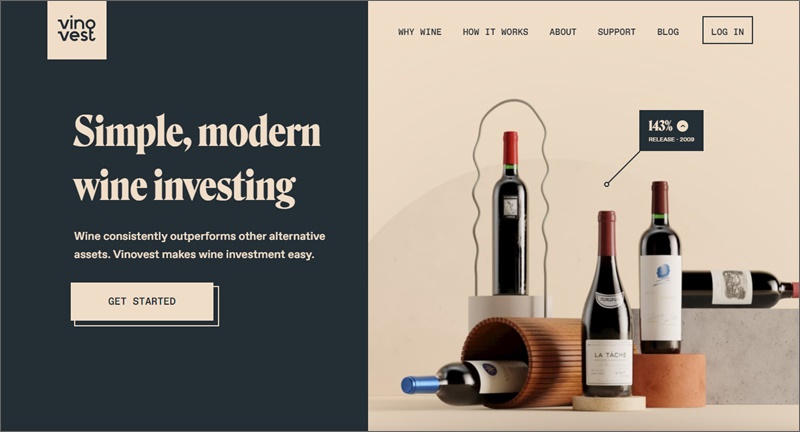
With Vinovest, you can buy a portfolio of fine wine starting with a $1000 minimum investment. The company handles all the storage and insurance, and you can “liquidate” (pun intended) your holdings relatively quickly.
According to the site, you can even request a bottle from your portfolio to drink yourself if you want!
Royalty Exchange – This innovative platform lets you buy future royalty rights to popular (and not-so-popular) music. It’s a way for artists to get paid cash today, and for investors to potentially earn passive income for years. In browsing the listings, I found tracks from Jay-Z, Rihanna, Drake, and more.
Cult Wines – According to WineInvestment.com, “Fine wine has consistently offered investors double-digit returns year-on-year.” This isn’t where I’d put my first bit of extra cash though; minimums start at £10,000.
Rally Rd – The Rally Rd app aims to crowdfund the purchase of potentially-appreciating assets like classic cars, fine wine, and other collectibles. As an investor, you can sell your “shares” in each collectible to other Rally Rd buyers, or get paid out when an asset gets re-sold.
Koia – “Invest in what you know and love,” like fine wine, classic cars and watches. Koia fractionalizes ownership in these alternative assets, especially for UK investors.
Business Lending
Business lending is a sub-category of peer-to-peer lending where you can lend your money to growing businesses that need extra cash to expand. Different platforms offer different “types” of loans and cater to different types of businesses, but the common thread is the companies don’t have to dilute their ownership stake because they’re just paying interest on debt instead of giving away equity.
And for investors, business lending represents the chance to support small business growth while earning attractive returns.
Kickfurther
On Kickfuther, you can help support growing e-commerce companies by lending them money for inventory. These small businesses are often plowing all their cash back into more product to sell, and pay an average of 19% annualized interest to help them acquire inventory faster.
(Accounting for defaults, that gets knocked back to a 7% average return on investment since mid-2017.)

My first batch of “consignments” — loans made through Kickfurther, didn’t perform particularly well. Since then, the company has put a number of new protections in place, including more stringent borrower credit score requirements.
For instance, borrowing companies are larger and more established now, with most doing over $1 million a year in sales. Kickfurther also inserts itself into the cash-flow management of the business, either payi