How do you connect with customers and grow your business?
This post will explore dozens of concrete ways to do just that, focusing on some of the most highly-trafficked websites. After all, the #1 challenge of marketing is to get your message in front of your target customers.
Why not do that in their natural habitat?
But before we dive in, let’s go back to basics for a second.
The 4 Ps of Marketing
In Marketing 101, you learn the 4 Ps of Marketing:
1. Product
If you’re still looking for the right product or service idea, check out this monster list for some inspiration. This is the foundation on which your business stands.
In the past, my “products” have included:
- Reselling Skittles at summer camp
- A babysitting service
- A house painting service
- A website review service
- Reselling clearance products on Amazon
- A book editing service
- A virtual assistant recruiting service
- A comparison shopping engine
- A private mastermind
- Self-published books
- A Udemy course
- Sponsorship spots on The Side Hustle Show
- T-shirts on Amazon
How do you make money? That’s your product.
2. Price
It will take some time to arrive at optimal pricing for your business, and it’s something I’m always curious about so it comes up in almost every episode of The Side Hustle Show.
For lack of confidence or fear of losing work, I often priced low when bidding for house painting jobs in college.
In some fields, low pricing is the key to building a portfolio, and this was the strategy my wife and her partner followed in building their photography business.

Kendell Rizzo had a similar approach to her building her $100k freelancing business on Fiverr. “Every time I was swamped, I’d double my rates,” she explained.
I’ve done the same thing on Clarity.fm, starting out at the bare minimum $60/hour and inching that rate up over time.
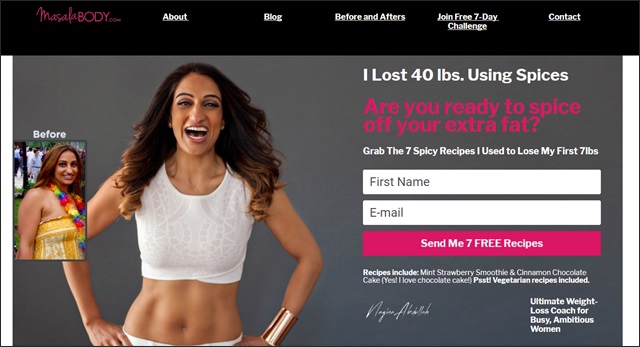
Others have taken the opposite approach, including Nagina Abdullah who confidently set her initial weight loss coaching package at $5000, even though she’d never done any paid coaching before.
In any case, if people aren’t buying, price is only ONE factor. Don’t be in a rush to slash prices just because you aren’t making any sales. Consider what other objections might be going through a prospect’s head first.
Related: For an excellent read on pricing, I recommend 80/20 Sales and Marketing by Perry Marshall. (You can get it on Amazon or for $0.01 + shipping here.)
3. Promotion
Promotion is how you spread the word about your business.
Big brands can afford to spend big money on TV and Radio ads, billboards, and newspaper ads, but the good news is you don’t have to have a million dollar ad budget (or any budget at all) to make money on the side.

You can promote your product, service, or blog on dozens of free channels if you tackle them right. In fact, that’s the main focus of this post: showing you exactly where you can tactfully and profitably promote your business.
4. Place (Distribution)
Where will customers do business with you?
If you’re like most side hustlers, your primary place of business is your website — though you can totally get started without one.
In fact, if you’re providing services or selling products locally or via Amazon or eBay, you might not need a website at all.
Related: The Fastest and Cheapest Way to Build a Great-Looking Website for your Side Hustle [Case Study]
The 3 Big Levers
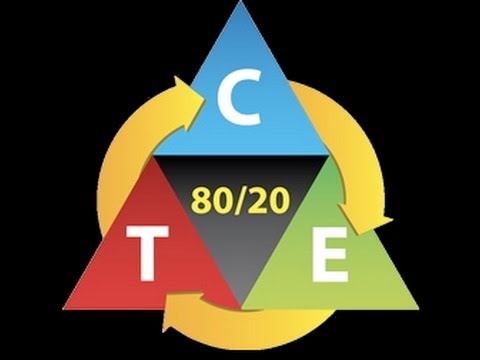
No matter what business you’re in, there are really only 3 levers to pull to make a meaningful impact on your bottom line:
- Prospects (how many people are exposed to your product or service)
- Conversion Rate (how many of those can you convince to buy from you)
- Price (how much you charge)
If you can significantly increase any one of those factors, you will make more money.
Perry Marshall calls this The Tactical Triangle of Traffic, Conversion, and Economics:
In this post, I’ll showcase the different ways you can get more prospects, visitors, and leads.
In marketing lingo, this is called the Top of the Funnel. How can you fill your pipeline with as many qualified prospects as possible?
The “Buy Buttons” Theory
 The basic challenge of marketing is to get your product or service in front of the right customers. If they don’t know you exist, it’s going to be awfully hard for you to sell them anything, right?
The best way to address this challenge is to simply find out where your target customers already are, and go there.
I call this the “Buy Buttons” strategy–I wrote a whole book about it–and it’s all about the platforms and marketplaces on which you can set up shop and take advantage of a pre-existing audience of buyers.
(If you prefer audio, you can get the audiobook free here!)
The Buy Buttons theory, or the concept of going where the cash is already flowing, is one to keep in mind for the rest of this post.
If you can reach your customer in their natural habitat, they’ll be far more receptive to your message.
Connecting with Customers on the 10 Most Popular Websites
If you want to reach more customers, go where they already are. There is always some fluctuation in the rankings over time, but these are the most popular websites in the country according to Alexa:
- YouTube
- Amazon
- Wikipedia
- Yahoo
Let’s see what you can do to connect with customers on these platforms.
1. Connect with Customers on Google
As the #1 website in the world, it’s tough to ignore Google if you’re looking to get more visitors to your site. Google traffic comes in two main flavors:
- Paid advertising
- Organic (free)
Advertising on Google
For years, my comparison shopping site relied on Google keyword ads for most of its traffic, and Anton Kraly advocated their Product Listing Ads for driving traffic to his drop shipping stores.
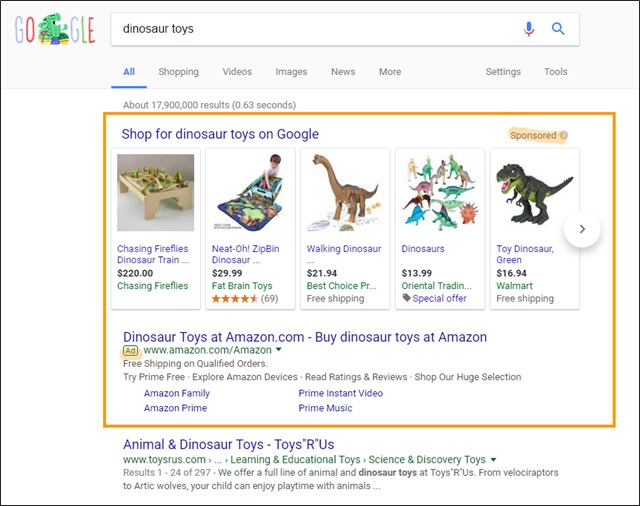
It’s a beautiful model: if you’re willing to pay, you can get your product or service visible to people typing in exactly what you have to offer!
Several other Side Hustle Show guests have mentioned using Google Ads to get their first customers, including Rene Delgado for his drop shipping store, and Timika Downes for her brick-and-mortar lice clinic.
SEO – Search Engine Optimization
Lately though, my focus has shifted more toward SEO, the art and science of getting free traffic from Google through their organic search results. I haven’t worried too much about link-building — though it is an important part of the ranking algorithm — instead I’ve focused on creating and promoting killer content.
Still, Google accounts for over half my traffic so I’m always trying to keep my pulse on what’s working and what’s not. I’ve gone through a couple rounds of my content audit process, during which I deleted tons of outdated, irrelevant, or low-quality content to improve this site’s position in Google.
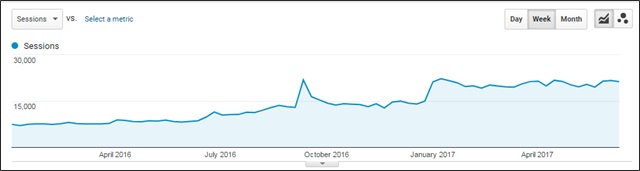
I also dove into the Google Search Console, a free resource provided by Google, to see if I could make some small tweaks to get more traffic to pages that were already getting impressions. The experiment was a success!
Homework: What keywords might potential customers be typing in to find you? Do you have killer content targeting those keywords?
2. Finding Your Audience on YouTube
YouTube is famously the world’s 2nd largest search engine (behind Google), but is far less competitive.
Some side hustlers have built entire businesses on YouTube, like Gabby Wallace did with Go Natural English, but others have simply used it has a smart marketing channel.
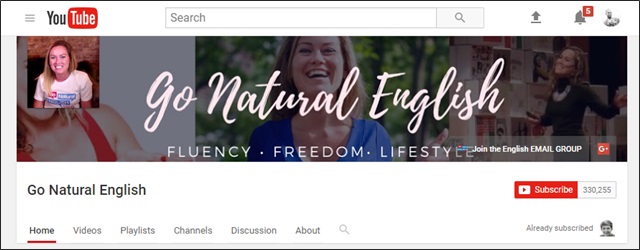
Both Jacques Hopkins and Colin Jones credited YouTube with driving a significant share of their traffic and customers. (They have online businesses teaching people to play piano and to count cards, respectively.)
Even though I have no desire to be a “YouTuber”, I include YouTube in my marketing plans in a few different ways, such as:
- Creating one-off tutorial videos when I learn a new skill or to answer a specific question.
- Syndicating podcast episodes to YouTube, where the top shows have tens of thousands of incremental listens. I’ll take it!
- Creating a free mini-course on how to start a blog.
Homework: Do you have a video for your primary keywords? If you don’t, you’re missing out. How can you use YouTube to educate or entertain your target customers?
3. Marketing Your Side Hustle on Facebook
Underneath the Facebook umbrella are actually 3 pretty distinct areas:
- Your personal account
- Facebook groups
- Facebook Ads
Each comes with their own unique nuances and strategies.
Your Personal Facebook Profile
For your personal account, this is actually a great place to let the world first know about your new business. It all starts with your network, right?
This can be as simple as a post saying you’ve started a new blog, a new podcast, a new photography business, whatever your side hustle may be.
Especially on the service side, this is where you’ll often find your first clients. Even if those in your immediate circle of Facebook friends might not need your service, simply letting them know you offer it opens you up to the 2nd degree of referrals. When someone they know needs help in your area of expertise, you’re top of mind.
I call this tapping into your network’s network.
Facebook Groups
With Facebook groups, you can’t really come in guns a’ blazing and spam up the place posting your own links all the time. You have to contribute to the community and offer to help wherever you can.
Gabe Arnold of CopywriterToday.net shared on the podcast how he would join Facebook groups filled with his target clients and literally use the search bar to search for words like “help”. He was looking for threads where people were asking for help, suggestions, advice, and recommendations.
If it was a fit for his expertise, he’d chime in and offer his support. Over time, he became a trusted member of the group and these helpful comments sparked several conversations that ultimately led to sales and referrals.
To drive traffic from Facebook groups, I’ve shared interviews I’ve done with prominent group members. With enough lead time you can even start a thread letting the group know you’re interviewing so-and-so and ask for input on what questions to ask.

Later, when the post or interview is live, you can post the link at the bottom of the thread and it will bump it back to the top of the group — and everyone who commented will get a notification.
Teresa Greenway built her business to several thousand dollars a month teaching sourdough baking online. Yes, really! Her secret sauce is an engaged tribe in one of the largest baking groups on Facebook.
Related: I’d love to have you join the official Side Hustle Nation group.
Homework: Join at least one Facebook group comprised of your target customers.
Facebook Ads
And finally, Facebook Ads can be a powerful driver of new traffic, leads, and sales. As Kamila Gornia explained on the podcast, you need to have a strategy in place before you start advertising, but once you do, it can be off to the races.
For ecommerce stores, you can drive Facebook ads directly to your product.
For bloggers and freelancers, you can drive Facebook ads to a lead magnet. Kamila said the more “instant gratification” the lead magnet provides, the better. It varies by industry, but paying $1-5 per lead seems to be a common range.
My primary use of Facebook ads so far has been to drive extra traffic to “money posts” — those blog posts heavily monetized with affiliate links, like this one.

If you’re just starting out, you can even use Facebook ads to quickly validate your idea.
To validate their Loan Signing System business, Mark Wills and Roman Rosario spent $20 on Facebook and got around 30 people to sign-up solely to be notified when (and if) they ultimately launched their product.
Related: How to Make Money on Facebook
4. Connect with Customers on Amazon
I recently realized how in any given month, I have half a dozen income streams tied directly to Amazon:
- Amazon FBA for physical products
- Merch by Amazon for print-on-demand t-shirts
- The Amazon Associates program for affiliate links from this site
- Kindle book sales
- Physical book sales (print-on-demand, though Amazon’s KDP Print program)
- Audiobook sales (through Audible, owned by Amazon)
The e-commerce giant has built an enormous ecosystem that’s perfect for side hustlers to take advantage of both for physical and digital products.
For Physical Products
Amazon is the ultimate “Buy Button” marketplace. Since more than half of all online shoppers now start their search on Amazon, there’s nowhere better to be.
Savvy entrepreneurs are using Amazon’s impressive logistics network to build their own private label ecommerce brands, where others are taking the wholesale approach and helping other brands make more sales.
For Digital Products, Service, and Audience Businesses
For digital products, self-publishing on Amazon was one of my first (and most rewarding) side hustles.
I’m even giving a book away completely for free for the purpose of building trust and increasing exposure.
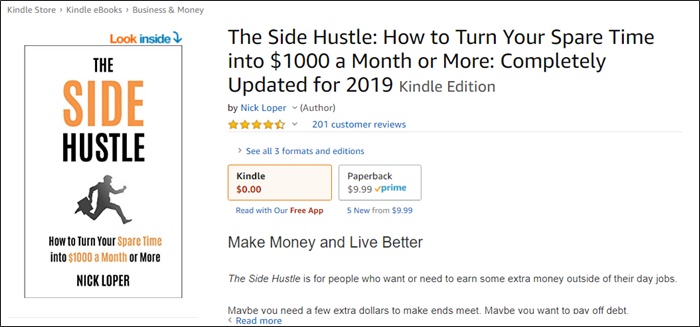
You can grab a copy here if you want to check it out!
As far as marketing goes, Amazon is another search engine to plan for. If someone types in your target keyword, will they find you or your product? (You can get to the top of the charts organically or with their paid advertising options.)
Homework: What product could you list on Amazon?
5. Marketing on Reddit
Reddit is “the front page of the Internet,” but is still somewhat of an intimidating place for me.
I’ve never spent the time to learn how it all works and embed myself in the community, but others, like Brian Swichkow, have made an entire career of it.
This isn’t the place to come in guns ablazin’ promoting yourself, but more about gently inserting yourself and your business into the conversation.
6. Wikipedia
Getting your business listed on Wikipedia isn’t easy, but can be one way to take up more real estate in the search results.
Perhaps a more viable strategy though is to have your website cited as a source on Wikipedia.
A few of my posts been cited, including this one on the Wikipedia page about raw feeding:
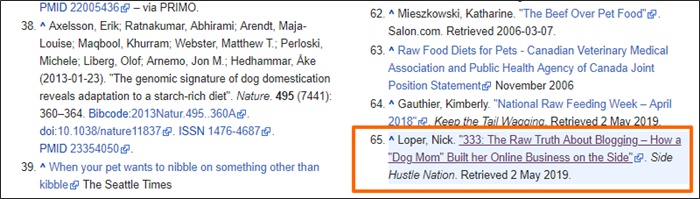
I wouldn’t expect to get a ton of traffic or business from it, but it’s probably a decent authority-building link in the eyes of Google. (Although it is “nofollow”.)
7. Marketing on Yahoo
If you’ve got your Google SEO locked down, you’ll also be in good shape for Yahoo (and Bing) search.
Through the Bing ads platform, you can run marketing campaigns to the audience of both sites.
8. Connect with Customers on Twitter
Although Twitter accounts for less than 1% of my site traffic, I still like it as a place to make connections and share content.
I think it’s a great place to start conversations and not-so-great of a broadcast medium, even if I don’t always treat it like that.
My friend Mike Kawula wrote an entire book on Twitter Marketing that’s definitely worth checking out if your target audience is on Twitter. (And 300 million people use Twitter every month.)
9. Mining LinkedIn for Leads and Clients
My LinkedIn strategies are far less sophisticated than some, but I still view the “professional” social network as an important weapon in my marketing arsenal.
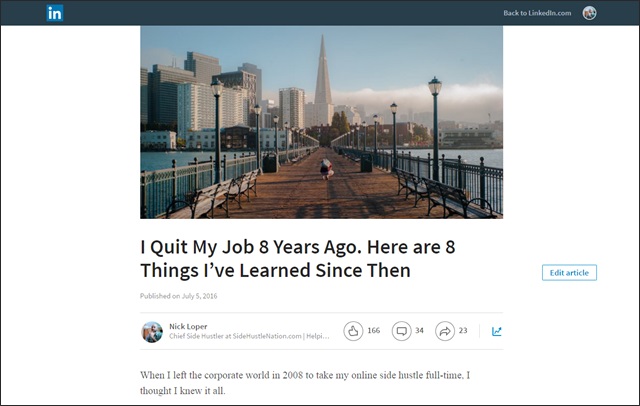
I re-publish some of my articles there to reach a potentially broader audience (this is my best-performing one so far) and share links to other content as well.
On the podcast, Joshua Jordison gave me an in-depth breakdown on how to make your LinkedIn profile shine, and how to build genuine connections (and your email list).
And ultimately that’s what the platform is best for: making one-on-one connections.
In fact, one of my guests booked $32,000 worth of social media management work just by pounding the virtual pavement on LinkedIn.
10. Growing Your Business on Instagram
With more than 1 billion monthly active users, Instagram is certainly a social media force to be reckoned with.
Even though I don’t post very often and don’t really use it for business (yet?), Instagram is usually the first app I check when I’m “making my rounds.”
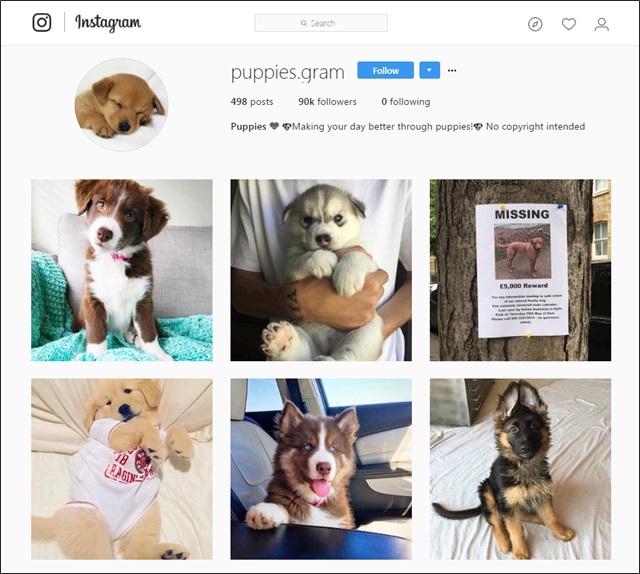
The Instagram user base skews a little younger than Facebook, so if you’re targeting a younger crowd, this is the place to be.
The IG can be an interesting place to connect with potential customers who might not be proactively searching for your product or service. This was the case for April Whitney, who used the app to build her tribe and side hustle in the fitness space.
Other Ways to Connect with Customers and Grow Your Business
Of course, the Top 10 sites are a great place to start, but they’re not the only way to generate more traffic, leads, and customers.
Pinterest Marketing
I’d never given Pinterest a second thought until Rosemarie Groner told me I was missing the boat — big time. And she was right!
She explained how Pinterest is a search engine for content a